What makes an actual scientist? It is probably someone who knows facts about nature. You might even continue the argument by saying that it is someone who completely blocks their emotive biases and can think logically. It is correct that serious scientific works lack preferences and are built upon a well-organized body of knowledge. However, it is often the case that the brilliant minds behind these cold-hearted scientific theorems are pretty emotional. This might sound surprising since people of this caliber are often portrayed in mainstream media as robotic and having monotone interests—for example, scientists in the Big Bang Theory and ‘Mr. Spock’s character in the Star Trek TV show is portrayed following this paradigm.
Nevertheless, similar to rebellious artworks like ‘Starry Night’ by Van Gogh and the works of Dostoyevski, a revolutionary scientific work requires a great deal of emotional inspiration and is born out of turmoiled minds. In this article, we are visiting 19th-century Dublin to analyze a strange figure, an alcoholic poet, who had many depressions for not marrying his love of life. Since we are in Dublin, you are probably guessing that I am talking about James Joyce, one of the best literature writers in history, or some other romantic figure. Except, I am talking about the greatest mathematical mind in Irish history, a polyglot who became an astronomy professor at the prestigious Trinity College in Dublin while he was an undergraduate, William Rowen Hamilton.
He is ‘the’ scientist who is deeply rooted in his emotions.
In a way, ‘quaternions’ -the mathematics behind quantum mechanics and various engineering applications are the descendants of the inspirations acquired from human emotions.
Could you have guessed? Probably not.
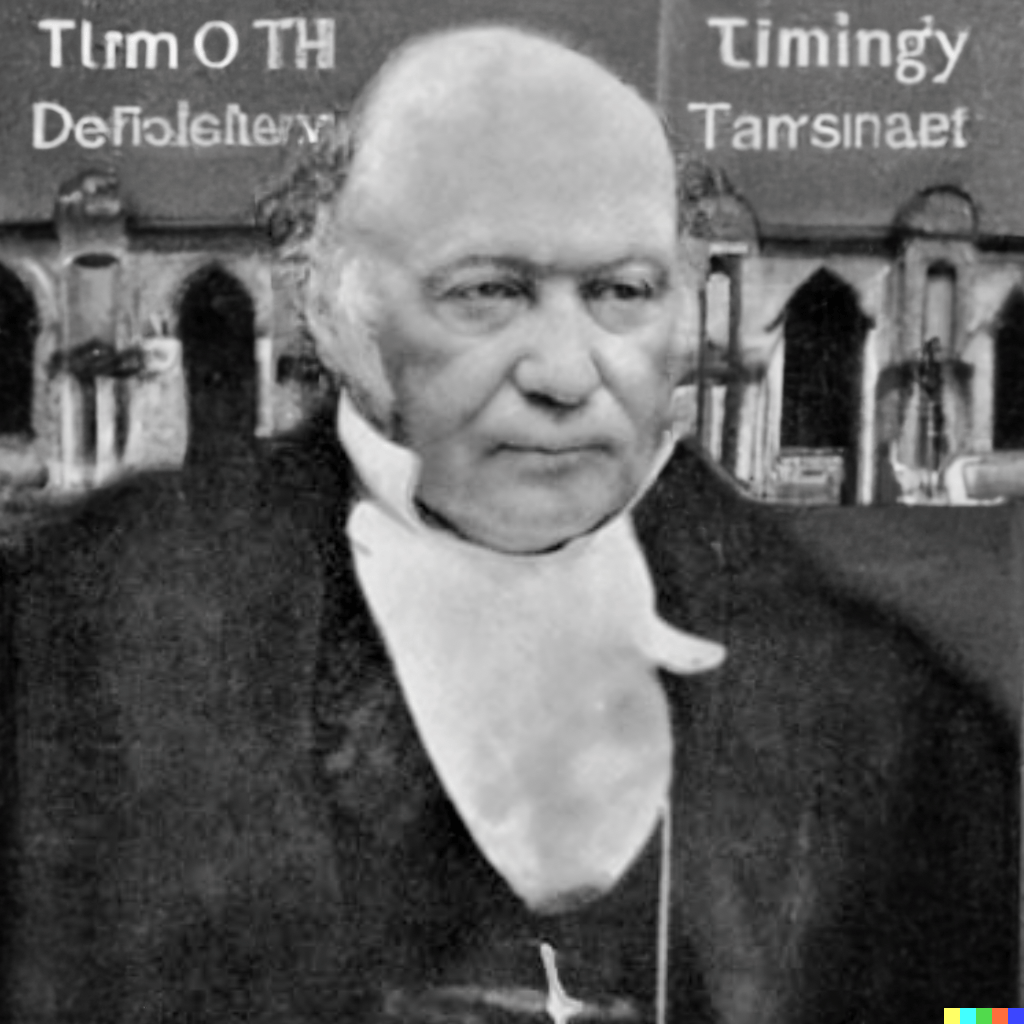
Photo of William Rowan Hamilton, the background is from Trinity College Dublin / Edited by Eren Erberk Erkul with the assistance of DALL·E 2
Quaternions – Eureka!
Hamilton had many noticeable works in optics as a professor of astronomy; this is quite expected. Although his passion, even in his childhood, was mathematics, and his most outstanding achievement came in pure mathematics.
Hamilton was obsessed with finding a way to find a way to multiply triples of numbers. He worked on the problem for months, and his struggle gained fame among his fellows. Even his kids were mocking him at the dinner table, asking him constantly about his progress.
Then on a typical Dublin afternoon, everything came to him…
Imagine a breeze of the Atlantic ocean hitting your face. Rays of the sun are fighting with clouds to reach your pale face—a magnificent scene but as a lifelong Dubliner, nothing out of the ordinary. Your wife is constantly talking to you, but you are not bothering her, maybe because of your lack of love, or you are still thinking about your beloved Catherine. Lost in the infinite dimensions of numbers, you feel like you are there but not there at the same time. You feel focused and determined to solve the puzzle attached to your mind, but there is something different this time. It is as if you are not trying to derive the numbers, but numbers are trying to derive you. When you stepped on the old stone bridge, all was clear. Suddenly, you understand now you are more than the flesh and blood that forms you. You are Yuri Gagarin touching space; you are Beethoven composing the famous fifth. Right now, you are expanding what it means to be a human and giving birth to a new dawn for humanity. With that energy and the clearest mind that any human being hopes to possess, you jump down and crave the new symphony on the bridge. This symphony is neither yours nor Dublin’s anymore because human existence is much subtler, much more complex. It will march into the future, getting more robust in the minds of your intellectual descendants, creating ideas like quantum mechanics, and who knows what more is yet to come. You look deep into the lake, reflecting your image, thinking about all this simultaneously. And all you can say with a deep sigh is Eureka!

Photo of Broome Bridge, Dublin, Ireland / Edited by Eren Erberk Erkul with the assistance of DALL·E 2
Intuition Behind Mathematics of Quaternions
Mathematical proofs of quaternions require a solid background that could be expected from a mathematician or a physicist. However, I will explain the basic principles and applications of quaternions for whom are interested. As stated, Hamilton discovered the Quaternions while trying to find a general rule to multiply triples. Unlike simple, complex numbers, triples contain two complex parts and one imaginary part. In a way, Hamilton was trying to extend the complex plane by adding an extra dimension to the field. However, in mathematics, every parameter you add must be expressed concisely and logically. He could add and subtract using this newly added complex dimension but was having difficulties in their multiplication. This difficulty arose from the indeterminacy of the multiplication of two complex components from these two fields. Hamilton’s inspiration while walking on the Broome’s Bridge in Dublin was seeing the impossibility of this multiplication and a need for an extra complex component. In other words, he saw that by adding a third complex component, all the difficulties in the multiplication of triples could be resolved. One of the most intriguing facts about quaternions is that the multiplication of the free complex components corresponding to 3 different vectors i,j, and k, respectively( each quaternion can be shown as a unit vector that has an elegant proof) can not commute, meaning the order of their multiplication can not be disregarded. At the time of Hamilton, this property was quite abstract and seemed absurd, as the multiplication in the natural or reel number domain is commutative. Even while writing the famous children’s book ‘Alice’s Wonderland’ written by an Oxford/Christ Church mathematician Lewis Caroll put some references to show the absurdity of the noncommutativity of quaternions. Nevertheless, the noncommutativity property is closely linked with the addition of the third element by Hamilton and is shown to correspond geometrically to rotations or calculations in the 3D plane. Hence in Quantum Mechanics, which delves into rotational calculations in three dimensions, or modern-day computational graphics, quaternions are an exceptional tool.
Dimensions / Photo by Eren Erberk Erkul with the assistance of DALL·E
08.12.2024 P.S.
I was kindly informed by Anne van Weerden that there are sources claiming William Rowan Hamilton was neither an alcoholic nor unhappily married, but rather a devoted family man. You can learn more about this perspective by visiting the following links:
Useful links:
https://mathshistory.st-andrews.ac.uk/Biographies/Hamilton/
https://www.ria.ie/hamilton-did-it/who-hamilton
https://www.emis.de/classics/Hamilton/index.html
https://mathworld.wolfram.com/Quaternion.html