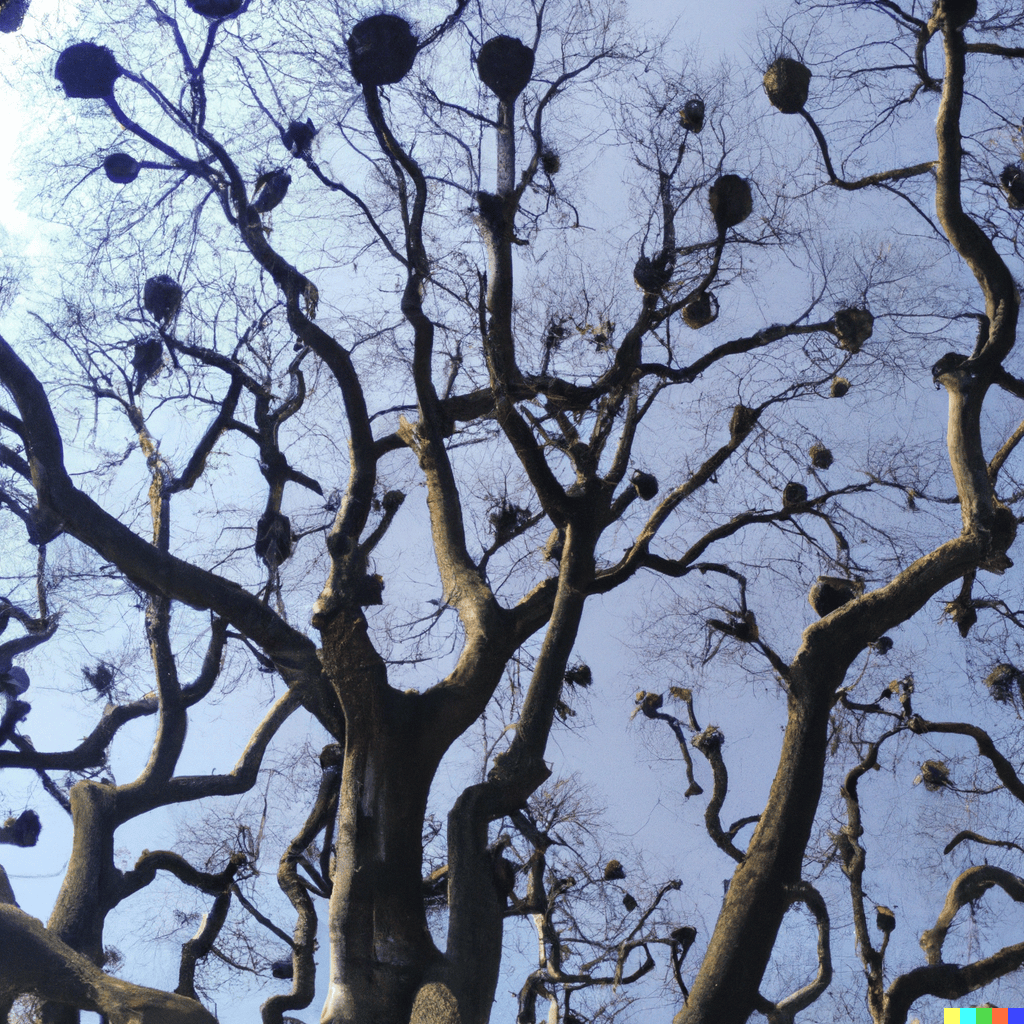
Trees as Neurons / Drawing by Eren Erberk Erkul with the assistance of DALL·E 2
Case for physics
One of the reasons I wanted to study physics is because it is the most fundamental of sciences and an elegant intellectual endeavor. It tries to explain the smallest of matter, with the contemporary quantum theories and the highest gravitating objects, using the general theory of relativity. So discretely using the standard model and GR, excluding places where both GR and quantum are effective, you can explain and understand everything. Also, theoretical physicists are trying marry general relativity and standard model to explain the absolute raw power of the universe in the simplest elegant equation, including the problematic areas that I have mentioned. With all the respect in the world, the whole of chemistry is built upon and explained generally using the standard model, and the biggest revolutions in the field are a direct consequence of the paradigm shifts in physics. Biology is built upon the principles in chemistry, and its development was hand in hand correlated with our understanding of electricity. Until very modern times, scientists considered electricity to be the eternal source of life. In addition, the revolutions in biology were possible to the degree of accuracy the imaging systems brought, which were fundamentally discovered by physicists and developed by electrical engineers. The discovery of DNA and the innovation made by Wilhelm Röntgen is a direct proof of what I claimed. Richard Dawkins, an acclaimed evolutionary biologist, in a panel with Neil DeGrasse Tyson, even mentioned biology as a junior science compared to physics. I know that the revolutions in chemistry and biology are as consequential as the discoveries in physics. However, in terms of fundamentality, physics is no doubt ‘the’ science, and the other disciplines are approximations and consequences of its laws. So, while studying it, a person can predict the occurrences of natural phenomena and grasp the texture of reality itself! Is it not the most extraordinary superpower?
Case for neuroscience
Neuroscience might have, beyond mathematics, the best argument against physics being the most fundamental science. It might be possible to simulate the thought processes of the brightest individuals in history, even in physics, such as Einstein, Maxwell, and Dirac, to find the quantum gravity equations without needing an army of intellectuals. So if we could find a scientific theory that could simulate the most fundamental ideas in the human mind externally, which is, ironically, ideas in physics, does this make the discipline most fundamental? Well, I think it does not, as I believe the laws of physics would be eminent without the existence of the human mind and thought. So, a method of creating the perception of understanding the universe in the human mind is not apriori to the existence of the universe and its laws. One might oppose my ideas while approaching this argument with unbounded lenses of philosophical ideas that can not be proven due to the nature of these ideas. However, if we were to remain within the boundaries of sciences, which are built on the premises of materialism, my conclusion should be unavoidable.
Note: The popularity spike of biological disciplines such as virology, microbiology, and pathology after the covid outbreak in no way reflects the fundamentality of the discipline. Also, the discipline of neuroscience, in my argument, is separate from biology and its fields.
Case for mathematics
Mathematics is an art form. It is the most coherent and logical thought a human can possess. And in some ways, it is far more elegant and inclusive than the word fundamentality I have been using in the article. Since with mathematics, you can create and compensate on an infinite number of coherent systems which does not have to show consistency with our universe. So mathematics, in a way, is a subtler pursuit than physics. However, do any kind of art form and beauty make sense if it does not get inspired by reality? Here is a better question. Is there really an art form that is completely distinct from reality? I believe there is not, and maybe the abstract theorems of mathematics of today are the physics of tomorrow. History certainly is with me on this one, but will it also the tomorrow? In conclusion, mathematics is the most fundamental aspect of reality when it explains the cosmos, and when it does so, it becomes indistinguishable from physics. However, this is in no way to disregard the beauty and importance of pure mathematics, as I believe it is the hardest discipline in the whole human intellectual endeavor.
Useful links:
https://www.feynmanlectures.caltech.edu/I_03.html