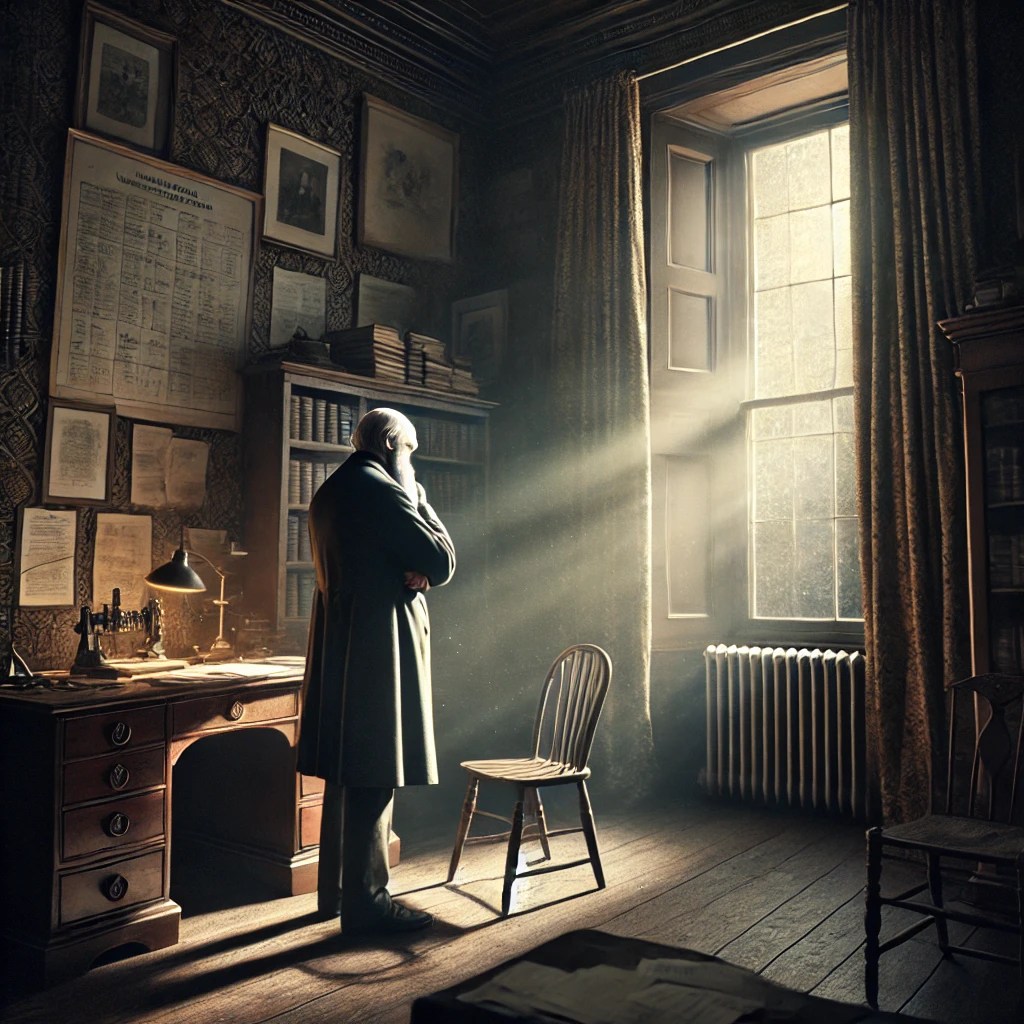

Drawn by Eren Erberk Erkul with the assistance of DALL·E
A single rebellious light wave departed from its fellow waves, striking the wall of a Victorian-era house in Cambridge. The dim study was as quiet as ever. Charles Darwin held a letter in his hands, the seal freshly broken. It was from a young man, a naturalist named Alfred Russel Wallace. Darwin’s eyes moved over the letter, then returned to the same lines.
Wallace had arrived at conclusions Darwin knew all too well, conclusions he had been too cautious to share. The timing of this discovery was both thrilling and terrifying. How could this be? Darwin thought. He is hitting the wall I’ve stood before, staring into the same darkness.
The rebellious light from the small gap in his curtains caught his eye. It danced across the wall, breaking from its expected path. A single wavelet, he thought, trying to escape through the smallest of cracks. How could it exist on its own? Could it act like something so solid? The idea seemed absurd. But Darwin shrugged it off; thankfully, he wasn’t a physicist. He didn’t need to waste his time on such matters. Yet, the analogy stayed with him.
In his carefully constructed life, he had chosen safety, chosen to let his revolutionary ideas lie dormant, like that trapped beam of light.
I have become a respected figure, he thought, an expert among my peers, a Fellow of the Royal Society, and at the forefront of academia, once I alienated. But am I not just like this single wave, hitting a wall, unable to light the whole room?
Darwin’s days of exploration felt distant now, an ideal once he had a requiem for a different kind of life. He had spent his youth journeying to the Galápagos Islands in Ecuador, observing nature for the sake of wonder alone. Once full of curiosity and determination, now, for most of his career, he stands still, sits in his study, reading another naturalist’s discoveries. The old notebook he once filled with radical thoughts about birds adapting to the local environments of the segregated islands, and his thesis that life itself is shaped by similar adaptations, like small rivers he had seen slowly diverging from the main flow of the Amazon. The fact that humans are not holy creatures but are the continuation and the representation of the success of adaptation, the experiment of life. It all lay untouched. That notebook, he reflected, was my waveguide. But it hit a wall long ago. I, too, hit a wall and chose to live a quiet, respected life. I’ve blended in so well with the world around me that I’ve almost forgotten what it means to rebel.
But the letter in his hands would not let him forget. Wallace had pushed forward with the same ideas Darwin had kept to himself. The wave was no longer alone, and Darwin could no longer assume that there would be time despite what his colleagues might think, despite what his intellectual forebearer Galileo might have severed from the religious authorities.
This is it, Darwin realized. Wallace is bold and young, has the courage he lacked, and how much longer can I remain here, watching the wall? My truth shall never be revealed, being part of the dust. His fingers tightened around the letter. I am not just a single wave, he thought, I am an orchestra ready to lead the wave. If he opened the curtain now, he wouldn’t just be a solitary beam breaking through; he would be a force strong enough to tear down the entire wall if necessary.
He set Wallace’s letter aside and picked up his old, dusty notebook from Galapagos. Its pages, though long untouched, were full of scribbles about evolution, its universality, and what it all might mean for the concept of life. He knew it was true not only logically, but he felt it. As he opened the curtains fully, the light flooded in, and he could almost hear the cry of that once lonely wave, now joined by many others to shine a new dawn.
Darwin thought of the publishing house in the heart of the town. He knew what had to be done. The ideas had lived long enough between the covers of his notebook. It was time to let them leave.
My beginning was to understand all beginnings,
My end will teach them where it all starts,
To show we’re the same in the pile of life,
Though we seem so far apart.