
Drawing by Eren Erberk Erkul with the assistance of DALL·E 2
Introduction
The concept of Einstenien relativity is one of the most celebrated and popularised topics in physics. This is because it is probably the first time one encounters such a world-shattering worldview about reality. For the servants of physics like me, the special theory of relativity, one can even say, ‘spiritually’ diverges from ideas of classical mechanics as it represents a rebellion, originality, a revolution that is even more consequential than the French Revolution founded by a strange young man, Albert Einstein. Relativity is not born out of mathematics; unlike many other contemporary theories of modern physics, it is born out of ‘Gedanken’ experiments (‘thought’ in german), and one could even say it lacked the qualities of a serious academic article. However, it was a coherent theory of mechanics powered by basic algebraic manipulations that a clever high schooler could comprehend. Now, imagine being a 50-year respectable physics professor at ETH, one of the most respectable institutions in Switzerland, and as usual, you are reading Annalen der Physics, your go-to daily scientific digest. Suddenly, you come across a familiar name, Einstein, your former student, who you termed as a ‘lazy dog,’ didn’t accept giving reference and basically forced him to work as a patent clerk. Then you read the unconventional article that is filled with experiments with moving trains and strange conclusions that forever change your understanding nature of time and space. Imagine the excitement and unconventionality of this situation. To me, the works and the character Einstein created represent exactly this excitement. Hopefully, at the end of this article, you will be able to share this joy.
Birth of Relativity- Newton, Mach, Einstein
The concept of relativity is ancient, and indeed Einstein was not the founder of it in the 20th century. Though Aristoteles and Descartes had their own principles of relativity, the first scientific founder of relativity should be credited to Galileo Galilei. Then, Newton famously upgraded it in the 17th century under his law of inertia. However, the spark of brilliance in questioning the absoluteness of space and time came with Ernst Mach, a German philosopher mathematician, and brilliant scientist, so Einstein, in this respect, is the intellectual descendent of Mach. Mach opposed the idea of Newton using Newton’s own famous ‘bucket’ thought experiment. So not only is Einstein deeply affected by the ideas of Mach but also by his philosophical methodology. Einstein, similar to Mach, devised countless thought experiments to create incredible physical theories. Unlike scientists like Micheal Faraday, his brilliance was that he could see the mathematical connections of these philosophical experiments to rigorous scientific research. So, to avoid diverging a lot from the main topic, let us return to the famous Bucket experiment. Newton considered space and time as absolute quantities of the universe. Absoluteness for time and space means the clock ticking here in Cyprus would be the same in Ankara, Cardiff, and throughout the universe. So, to create a plausible argument for the concept of absoluteness, Newton devised the famous ‘bucket’ experiment related to the motion of water inside relative to a bucket on Earth and in empty space, respectively. (Since the explanation is a bit long and requires further deviations from the original argument, I will post a link to St. Andrews University’s detailed description). In the end, Newton concluded with his thought experiment to define motion and forces logically; there must be a concept of absoluteness in space, which also suited his Catholic beliefs. The first challenge to Newtonian absoluteness came from Mach, similar to his German contemporaries like Nietzsche, who was questioning the very essence of life. So, unlike Newton, he disclaimed the absoluteness of space and argued that motion could not be defined in empty space as it is, according to him, literally nothing. In other words, motion is, and corresponding forces do not make sense without a suitable frame of reference. These are philosophical arguments and can not be experimentally tested as it is impossible to form completely empty space, at least for now. Regardless, questioning the connection between the nature of space and time and mechanics by Mach was a considerable step in the right direction. This is where Einstein came in; when he was a teenager and in his early undergraduate years, he was very curious about the nature of space and time. He was influenced heavily by Mach’s readings and knew Principia by heart. Moreover, he was constantly questioning the ideas concerning the fundamental nature of these parameters, more similar to a natural philosopher than a physicist at this particular point. Einstein was especially obsessed with the nature of light and believed light would be vital in understanding space and time. However, after graduating from the university, he could not attain a job in academia as he had a bad reputation among his university professors. All of this was about to change when the year struck 1905. A 26-year-old average patent clerk with ambitions in academia armed with his teenage dreams was about to change our understanding of reality.
Relativity was born!
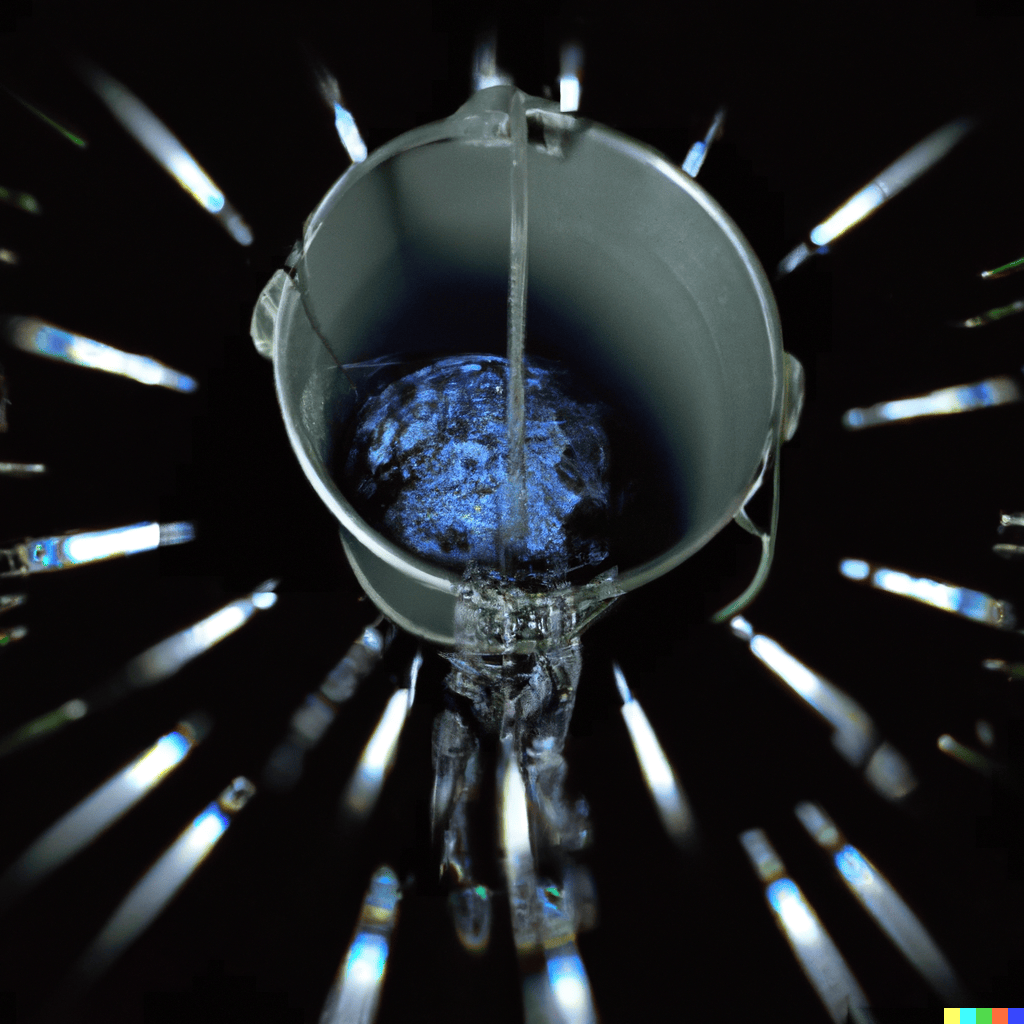
Drawing by Eren Erberk Erkul with the assistance of DALL·E 2
Postulates of Special Relativity

Drawing by Eren Erberk Erkul with the assistance of DALL·E 2
The most famous equation E=mc2
Conclusion
Relativity is crucial because it is the first theory to give a definitive mechanical framework for the nature of time. In classical mechanics, time was an independent parameter and can be perceived as a ghost forever doomed to watch over the cosmos. Thus, in the framework of relativity, time itself is manipulated to be more than this independent observer shying away from the action. But on the contrary, time became a key player in the mechanics of the universe. For me, the most complex aspect of life is the concept of time itself. We never stop and think about its true nature in our daily lives, yet it is the most fundamental element of our lives. Countless philosophers, poets, and scientists created an army of intellectuals that broke the shackles of generational boundaries and created rich stories and writings about it. Our grasp of the unified field theory of physics lies in our understanding of time. And it’s time once and for all to end the conundrum of intellectual pursuit regarding time by finally realizing its potential in the physics of the theoretical.
Useful Links :
https://einsteinpapers.press.princeton.edu
https://www.feynmanlectures.caltech.edu/I_15.html
https://mathshistory.st-andrews.ac.uk/HistTopics/Newton_bucket/