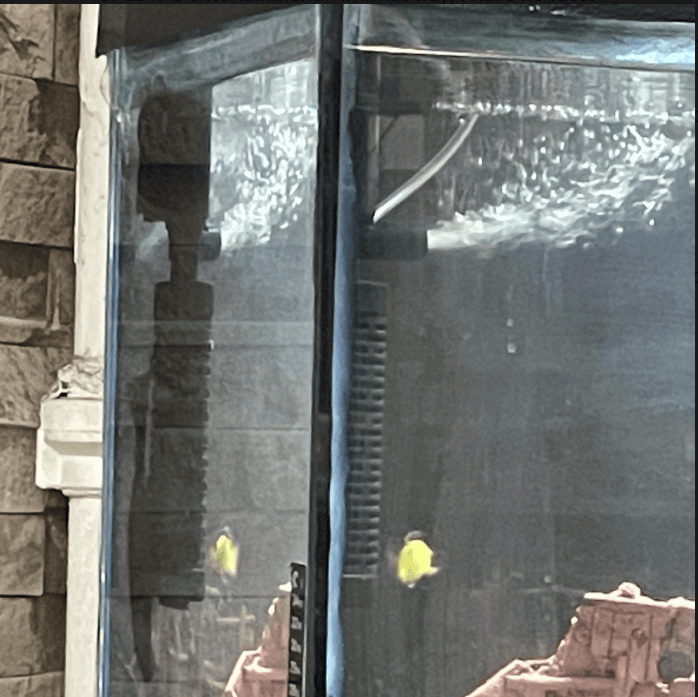
METU EE Canteen
The cosmos lives within everyday moments, and everyday moments reflect the cosmos. Being a naturalist isn't something you leave behind after answering a question; it's a way of seeing, inseparable from life itself. It's in the air you breathe, in the glamour of your pupil illuminated by photons scattering through it: an aquarium, a seemingly interesting object. For the fish inside, it is a prison, whether they perceive it that way or not, but for us, it is entertainment, in what way, I have no idea.
What I was focused on were the two consecutive glasses that constitute the aquarium. Through each glass, depending on the angle of light entering the aquarium, you see the fish at different lengths. This mundane phenomenon probably escapes everyone's notice. People's heads are loaded with so many irrelevant thoughts that it becomes difficult to see the miracle in everyday things.
But what truly caught my attention was the air conditioner inside the aquarium, supplying oxygen to the fish. The movement of air pumped through the aquarium created a shape resembling something so dear to me. I never cared about playing volleyball, but I've always enjoyed watching the ball's motion. Initially, the ball soars upward, but its momentum is gradually reduced by air resistance. Our beloved ball is then pushed aside and begins to fall, almost as if it had been beaten up so badly that you start to feel sorry for it. The trajectory created by the ball, a smooth parabola, is pure pleasure to imagine.
There, within the aquarium, was the same parabola. Only this time, the shape was created through the air's struggle against water. The water's buoyancy acted as gravity, and our beloved fallen hero, the ball, was carried by the air this time. The canvas was played by the air this time. How can this be? Isn't gravity responsible for this parabolic struggle of our ball? What is it that creates this struggle for our ball in the first place? In a sense, water is a physical object, along with air, responsible for the pressurized spherical shell of our ball. The interaction of this pressured ball and buoyancy, both very physical objects, creates what we see. Gravity, what is it? It is not a physical quantity, is it? Can you quantify it in terms of material entities? We can't. Instead, regardless of the object's nature or the material it is made of, we say the same force applies universally to the given unit entity, calling it mass. We don't even have a rigorous definition of what mass really is in General Relativity, and considering objects as strictly physical entities is also misleading. Within the theory, we can only truly talk about fluid objects. People become shocked when they learn about Newton's obsessive religious agenda. Well, how could you not? If I had discovered gravity instead of Newton in the 1600s, it would indeed seem as if God's hands were holding everything together. Nothing really changed like this force through Einstein. New players were introduced, such as the dynamic interplay between space and time creating gravitation, but the abstract characteristics of this mysterious force still stand.
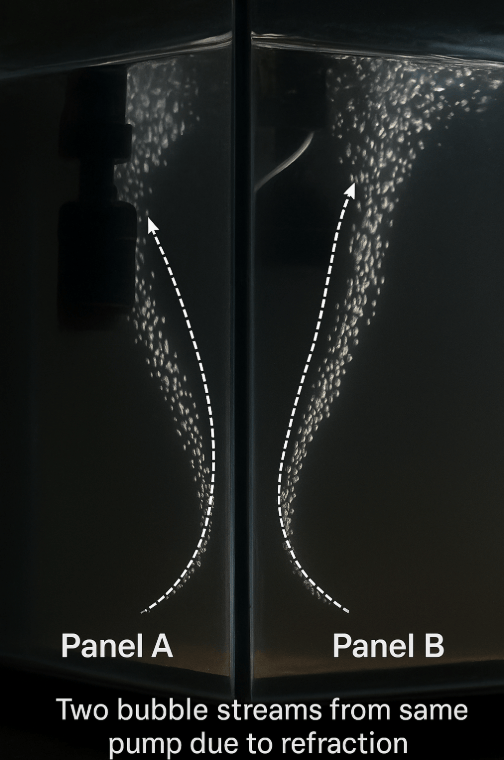
Imagine you are with me at the coffee shop, simultaneously observing the aquarium. I am looking through one side of the glass, and you are looking through the other. Then I ask you what length of trajectory you observe. If you are looking through side A, you would observe the length of the trajectory to be smaller than I do. If you know a bit of high school physics, you would say this is nothing impressive and explain that the light rays are refracted as they pass through the aquarium. But the point is that this is exactly how one would observe differences in gravitational trajectories if one could observe them from different inertial frames, which can be tied directly to Einstein's 1905 breakthrough, where he established the principle of simultaneity. In our thought experiment, each glass of the aquarium represents a different perspective of the same 'situation', observed from distinct inertial frames. Thus, looking through an infinite number of glasses forming a Cauchy sequence reflects the experience of observing a four-dimensional manifold and witnessing gravitational effects that the curved space is locally a flat space.
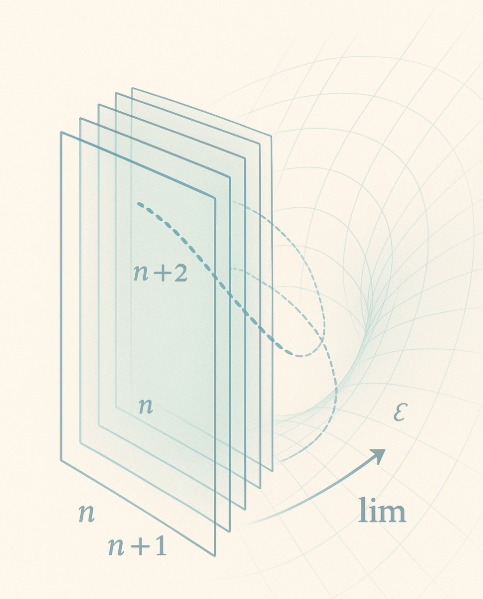
Cauchy Sequence of Aquarium Glass
Every time you play volleyball, remember, we don't yet fully understand what we mean by the mass of the object, nor what gravity really is that mysteriously creates these beautiful parabolas. Shockingly, such an everyday phenomenon remains not fully understood. However, if our fish tank behaves exactly like gravity would, could a fluid similar to that in a fish tank be responsible for gravitational buoyancy, with each of us as pressured spherical entities doomed in our gravitational trajectories? Is there an equivalent way of writing Einstein's equations in terms of physical quantities whose nature we can experimentally observe? These are excellent questions for another time. Peace out and stay with physics!