based on explanations of Prof. Ulf Leonhardt
1- Introduction
The fluctuation-dissipation theorem was first formulated by young Albert Einstein in 1905 (annus mirabilis) in his attempt to prove the existence of molecules. The particles jiggling around an object produce two effects. First, they slow down the object by introducing friction into the system. Additionally, they cause further fluctuations as they continue to move. This establishes a fundamental connection between the extent of an object’s fluctuations and the dissipation present in a system. Einstein applied this concept to Brownian motion, where a macroparticle undergoes fluctuations due to the presence of smaller atoms, which simultaneously introduce dissipation into the system.
These effects operate in tandem: the object experiences friction, slowing it down, while the continued motion of the surrounding particles leads to additional fluctuations. This relationship enables the calculation of the friction coefficient. At thermal equilibrium, an object in contact with surrounding atoms should exhibit a Boltzmann distribution for its movement. From this argument, it follows that a precise connection must exist between friction and fluctuations caused by atomic interactions. The friction coefficient serves as a measurable quantity to analyze the impact of atoms bouncing off an object. Einstein’s 1905 work , his PhD thesis, provides the first explicit derivation of this principle. [1]
2- A Quantum Perspective on Fluctuation-Dissipation
In quantum mechanics, the fluctuation-dissipation theorem takes on a distinct interpretation. In a way, quantum fluctuations do not exist in the classical sense. While quantum fluctuations are frequently discussed, their strict definition refers to statistical uncertainties that appear during the measurement process. When a measurement is performed, repeated trials may yield different results due to intrinsic quantum uncertainties. However, prior to measurement, there are no classical-style fluctuations. The quantum state exists in a well defined vacuum state, without random fluctuations. Despite this, quantum fluctuations can be thought of as virtual. They do not manifest directly as measurement results, yet they exist in principle. If one measures the amplitude of a quantum field, the outcome will show variations due to vacuum fluctuations. These vacuum fluctuations, while not real in the classical sense, have physical consequences that can be measured in specific optical experiments. A common misconception is the idea that the quantum vacuum consists of particle-antiparticle pairs spontaneously appearing and annihilating. While this model may be useful for fermions, it does not apply to bosons such as photons. The vacuum state of bosons does not contain real photon-antiphoton pairs. Instead, what fluctuates in the quantum vacuum are the electric fields. These fields do not remain exactly zero but fluctuate around zero due to the Heisenberg uncertainty relations:
This follows from the decomposition of field operators into modes, written as:
Since the real and imaginary components of a field amplitude cannot be simultaneously fixed, they obey Gaussian statistics, forming what is referred to as vacuum noise. This noise is not real in a classical sense, but it has measurable consequences when interacting with physical systems.
3- Experimental Evidence of Vacuum Noise
Experimental verification of vacuum noise has been achieved. A notable experiment in ETH Zurich by Prof. Jérôme Faist, demonstrated how vacuum fluctuations manifest in optical systems. A nonlinear crystal was used to rotate the polarization of a passing light pulse through a polarization-dependent nonlinearity. By cooling the crystal to nearly absolute zero using a dilution refrigerator, the terahertz radiation inside was brought to its vacuum state. Despite this, vacuum noise still altered the polarization state of the transmitted light.
In this experiment, two light pulses were sent through the crystal, and the resulting polarization noise was analyzed. The striking observation was that the noise exhibited correlations between the two pulses, even when they were causally disconnected, meaning no communication at the speed of light was possible between them. This provided direct experimental evidence of vacuum noise and its correlations beyond the classical light cone
4- Connection Between Fluctuation and Dissipation in Quantum Optics
Why Quantum Optics?
These primitive applications of fluctuation dissipation theorem arising from Quantum Optics go very far while explaning the phenemone. Quantum Optics is the field where non-equilibrium quantum statistic mechanics was mostly developed the reason being the demand for theoretical understanding of the laser. So, in laser one can see the emergence of many of the concepts of statistical physics such as the the noise properties, treshold saturation line width and everything related to them come together. This has become the testing ground for many of the concepts in statistical mechanics influencing many schools of theoretical physics that established the foundations of statistical mechanics.
Absorption
A clear example of dissipation in quantum optics is light absorption. Suppose a light beam with initial amplitude A enters an absorbing medium, producing an output amplitude B given by:
where η is the loss factor. The issue arises because the outgoing mode no longer maintains the same commutation relations. To correct this, an additional term must be introduced:
where A0 represents added noise from the environment. This additional noise term is required to preserve the underlying quantum structure, illustrating how dissipation necessarily introduces fluctuations.
Why is A0 necessarily a dissipation term?
This example is one of the simple cases where one can directly identify an application of the fluctuation-dissipation theorem. It can manifest in various mathematical forms, rather than just a single one. However, it is not a theory in the strict mathematical sense but rather an observation. For this reason, it would be more appropriate to refer to it as the fluctuation-dissipation law instead. This is similar to the spin-statistics theorem, which is also not a theory in the conventional sense. The connection between spin and statistics is primarily based on intuition rather than a rigorous mathematical derivation.
From a classical perspective, two main components determine the problem: the reservoir and what is referred to as the system. In this model, the reservoir is represented by a single mode, but in reality, linear loss occurs in multiple ways. Most absorbers function through some form of scattering, meaning that incoming light is not simply absorbed but instead redistributed in different directions. A common example is frosted glass, milk, or any white liquid. These materials are not absorbers in the sense that they convert energy into another form, such as heat; rather, they scatter the light.
A similar argument applies to other forms of light absorption. The A0 in this case may consist of multiple channels, yet their effect remains the same. Consequently, all such channels can be condensed into a single representative entity, A0, which accounts for all external noise sources within the system. This perspective, grounded in classical intuition, leads to the conclusion that this term necessarily represents dissipation.
Amplification
A similar problem occurs in amplification. If a light field passes through an amplifier, the output follows:
where G > 1 is the gain factor. However, this transformation alone is inconsistent. To resolve this, an added noise term must be included:
This additional noise originates from spontaneous emission, an unavoidable effect in quantum amplifiers. Moreover, the presence of such a term highlights the irreversibility of the amplification process by introducing additional uncertainty due to energy exchange with the external system.
Building on this foundation, consider a scenario where a vacuum input is applied to an amplifier. In this case, an output is inevitably produced because the mathematical treatment of the process transforms the vacuum state into an effective creation operator, resulting in the emergence of thermal noise. Consequently, an idle amplifier inherently generates thermal light. In fact, amplifiers are characterized by the thermal noise they produce, a feature that is directly related to the amplification factor, as derived earlier.
Nonetheless, while this analysis holds for an ideal amplifier free from external noise sources, most real-world amplifiers operate under less-than-ideal conditions. Each amplifier possesses an intrinsic quantum noise, precisely the factor obtained in our derivations. This quantum noise, which arises from stimulated emission, is intrinsically linked to the inversion required in the material for amplification. When a signal enters the amplifier, the inversion amplifies it; however, the same inversion condition also gives rise to spontaneous emission, thereby contributing to the overall amplification term.
5- The Lindblad Equation and Irreversible Processes
The most general mathematical formulation of fluctuation-dissipation principles in quantum mechanics is found in the Lindblad equation. It is the most general solution of the quantum master equations. For a density matrix ρ, its evolution follows:
The first and last term describe the unitary evolution governed by the Hamiltonian H (Von Neumann style commutator relation), where this is the imaginary Hamiltonian that is reversible, this is the dissipative component. The additional terms in the middle incorporate irreversible effects, with Ta representing transitional jump operators that model stochastic processes such as spontaneous emission and absorption. This represents the fluctuations in the system. Although pure von Neumann evolution does not change probabilities, these jump terms do, ensuring that the density matrix remains positive definite and normalised, thus preserving quantum mechanical consistency.
Furthermore, the fluctuation-dissipation theorem is inherently embedded in this formulation, governing both gain and loss processes. This framework represents the most general form of evolution of the density operators, ensuring a consistent interpretation of quantum energy. Without these terms, the wave function’s norm would not remain unity. To counteract its decay, statistical noise, manifesting as quantum jumps, preserves quantum properties, effectively realizing dissipation through these stochastic processes.
Note: An equivalent representation of the Lindblad formulation can be derived using a quantum oscillator model. In this approach, the system’s gain and loss in a quantum harmonic oscillator are modeled by choosing the T operator as either the annihilation operator (for absorption, which removes quanta) or the creation operator (for amplification, which adds quanta). In the Schrödinger picture, the density matrix evolves according to the Lindblad master equation incorporating these jump operators, whereas in the Heisenberg picture, the operators evolve while the state remains fixed, corresponding to the harmonic oscillator. Both approaches yield the same overall dynamics, with the essential added noise preserving the quantum commutation relations and ensuring that the oscillator functions correctly in modeling both damping and amplification. For more details check the reference [3].
6- Conclusion
Quantum mechanics is dazzling. To demonstrate this, imagine n photons interacting with a wall. Each photon will either be transmitted or absorbed. What would you expect? Well, they are bosons and fundamentally should be indistinguishable. Think of being a photon, how would you identify yourself from your fellow photons? Well, in turn, the photon could ask you the same question, perhaps even taking offense: How do you distinguish yourself from your fellow humans? But let’s ignore that for the sake of this discussion. 🙂
The fascinating part is that when experiments are conducted, the absorption spectra of the photons follow a binomial distribution, as shown in the plot below. This means they behave as distinguishable objects. The reason behind this lies in the nature of the absorption process within the medium. When a photon is absorbed, it ceases to exist in its original mode, meaning that quantum interference effects between different absorption events do not influence the final statistics. This effectively isolates each absorption/transmission event for every quantum of light.
Thus, in absorption events, photons do not interfere with each other as they would in scattering and interference experiments. The fundamental reason is that absorption inherently involves an interaction with a macroscopic environment, which forces the photon to collapse into a specific presence. Think of each photon like Schrödinger’s cat, and the absorption event as the act of opening the box, except, in this case, each cat is observed separately.
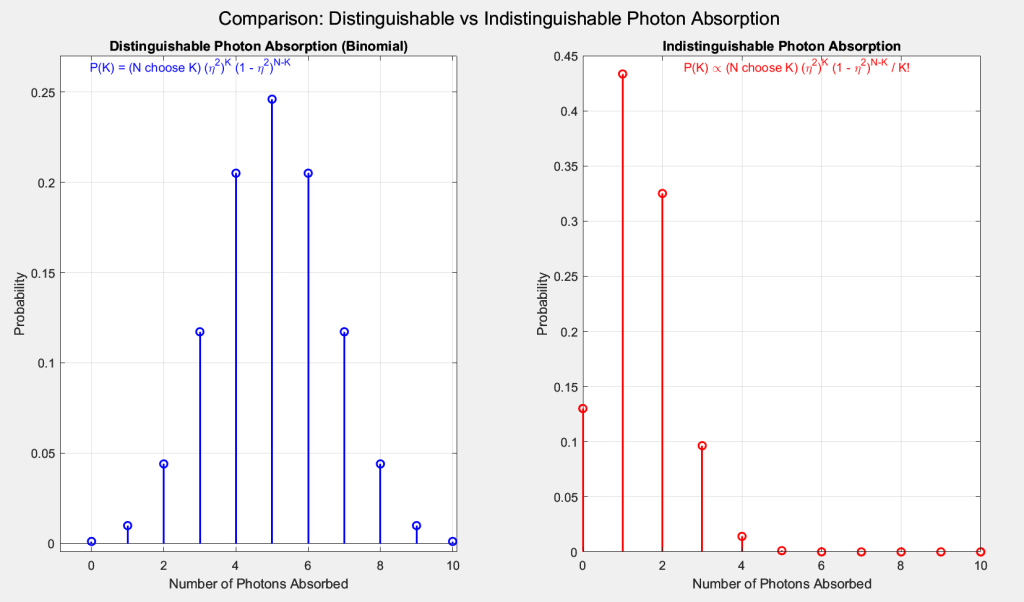
A photon, in this case, is a quantum object, existing as an abstract entity within its respective Cauchy-convergent complex inner product space, Hilbert Space. These mathematical constructs are majestic, and in theory, everything fits together. But beyond the theoretical beauty, as demonstrated in the photon absorption case, we can observe these abstract entities in real experiments. This makes them REAL, that is the most shocking realisation of all.
Now, consider an abstract space filled with quantum noise. Does it experience heat dissipation? Does it have fluctuations? But how can a complex vector space fluctuate? Can we truly perceive it? Is it real? As discussed in the article, and similar to the case with photons, the effects of these fluctuations have been experimentally observed in Zurich, appearing in the amplitude of light waves.
This raises a deeper question: if we cannot directly observe quantum fluctuations, do they truly exist? Does observing only the effects of an object make the object real? The essence of quantum mechanics lies in this very paradox: we can never fully know the entire state of a system, only certain measurable aspects, such as its initial conditions, while its transition states remain hidden. The system acts as a black box, we observe only the amplitudes of complex wave functions, never the quantum objects themselves. In this sense, we still do not fully understand the inner workings of quantum mechanics.
But can we dismiss the fluctuation-dissipation theorem simply because its effects, rather than the fluctuations themselves, are observed? What is the fundamental source of heat dissipation in a system? More than a century ago, Einstein’s classical analogy helped us conceptualize dissipation and fluctuation in thermodynamic systems, and remarkably, this concept still works in quantum mechanics. But why does it work so well?
In quantum optics as we have discussed, the fluctuation-dissipation theorem emerges naturally. In absorption and amplification processes, it manifests through absorption and gain coefficients. In a deeper framework, it appears in the Lindblad equation, governing transition jump coefficients to ensure consistency in quantum mechanics.
With Prof. Leonhardt and generations of physicists before us, we are certain that this is far from the end. The constant fascination and curiosity that led us to physics in the first place will eventually guide us toward unraveling the deeper mechanisms behind these phenomena, perhaps even explaining the collapse of the wavefunction and the quantum vacuum through the fluctuation-dissipation theorem. In particular, understanding the quantum vacuum could be the key to unlocking quantum gravity. Instead of adding layers of abstraction, as string theorists attempt, we must strive to uncover the working mechanisms hidden within these formalisms.
References
[1] Einstein, A. (1905). Über die von der molekularkinetischen Theorie der Wärme geforderte Bewegung von in ruhenden Flüssigkeiten suspendierten Teilchen. Annalen der Physik, 322(8), 549–560. doi:10.1002/andp.19053220806.
[2] Lindblad, G. (1976). On the generators of quantum dynamical semigroups. Communications in Mathematical Physics, 48, 119–130. doi:10.1007/BF01608499.
[3] Leonhardt, U. (2010). Essential Quantum Optics: From Quantum Measurements to Black Holes. Cambridge University Press. doi:10.1017/CBO9780511806117.
[4] Benea-Chelmus, I.-C., Settembrini, F. F., Scalari, G., & Faist, J. (2019). Electric field correlation measurements on the electromagnetic vacuum state. Nature, 568, 202–206. doi:10.1038/s41586-019-1083-9.
[5] Settembrini, F. F., Lindel, F., Herter, A. M., Buhmann, S. Y., & Faist, J. (2022). Detection of quantum-vacuum field correlations outside the light cone. Nature Communications, 13, 3383. doi:10.1038/s41467-022-31081-1.
[6] Caves, C. M. (1982). Quantum limits on noise in linear amplifiers. Physical Review D, 26, 1817–1839. doi:10.1103/PhysRevD.26.1817.
[7] Callen, H. B., & Welton, T. A. (1951). Irreversibility and Generalized Noise. Physical Review, 83, 34–40. doi:10.1103/PhysRev.83.34.