based on explanations of Prof. Ulf Leonhardt

Granular Dispersion drawn with the assistance of Dall-E
Introduction
This derivation illustrates how dispersion emerges, assuming spacetime is inherently granular. As Prof. Leonhardt often points out, like many profound ideas in physics, this concept has its roots in a primitive yet powerful idea from condensed matter physics.
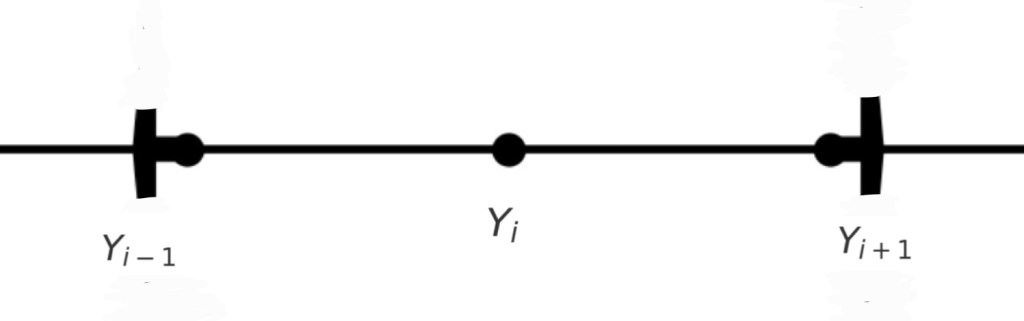
Consider replacing the smooth fabric of spacetime with a granular, lattice-like structure. We aim to model the interactions between these lattice nodes as simple harmonic oscillators and capture the whole spacetime structure as a composite harmonic oscillator. This approach reveals that the resulting wave equation corresponding to spacetime exhibits dispersion.
Similar to the Ising model in statistical mechanics, we assume that only neighboring points interact—thanks to Prof. Halilsoy for this insightful comment.
Part One – Composite Harmonic Oscillator
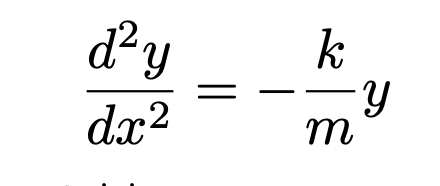
We start with the equation for a simple harmonic oscillator:
Now, we consider the case of coupled oscillators. The displacement of each oscillator is influenced by its nearest neighbors.
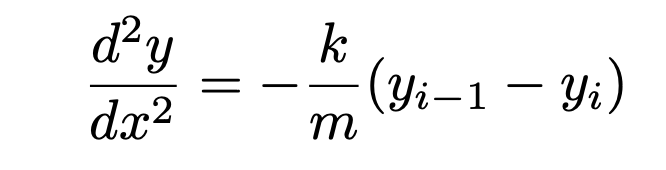
Coupled Oscillator Equation for Yi-1
This equation describes the influence of the previous oscillator Yi-1 on the current oscillator Yi.
Coupled Oscillator Equation for Yi+1
This equation describes the influence of the next oscillator Yi+1 on the current oscillator Yi .
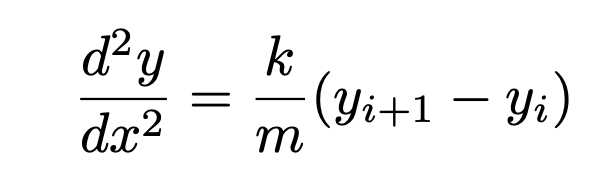
By summing up the neighborhing equations the composite equation becomes:
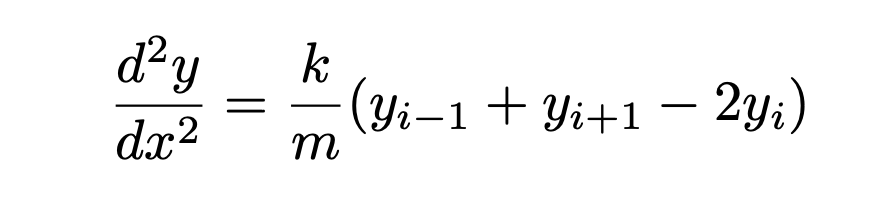
Part Two – Taylor Expansion with respect to time around the midpoint
We Taylor expand Yi-1 and Yi+1 with respect to time around Yi. Where δ is the increment between consequative nodes.

Taylor Expansion for Yi+1 :

Taylor Expansion for Yi-1 :

Summing the Expansions:

We are left with only the even terms when we sum two infinite series term by term. Observing the dispersion is sufficient to consider terms up to the fourth derivative. The second derivative corresponds to a standard wave equation, while the fourth derivative accounts for the correction introduced by the dispersive medium.
Substitute into the composite equation
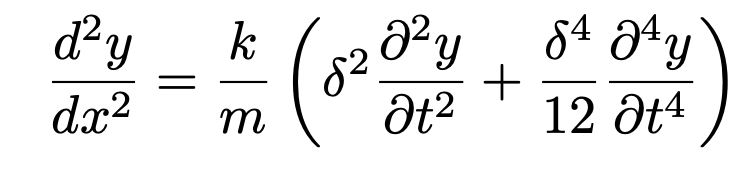
This equation is a dispersive wave equation.
Part Three – Finding the dispersive term
We assume a plane wave solution:

Derivatives for the Plane Wave Solution:
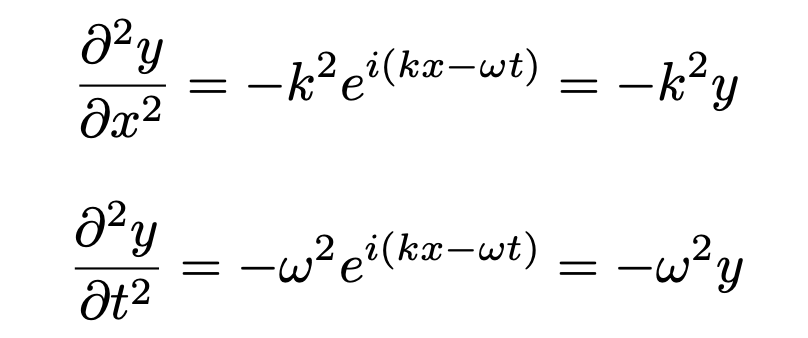
Substituting these into the modified composite equation of part two :

To avoid confusion with the notation, let us clarify that k represents the wave number, while Z refers to the spring constant. Hence, we rename the spring constant from the earlier sections as Z.
Algebraic Simplification :
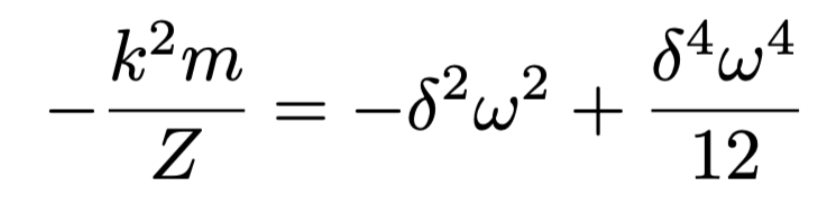
Rearranging:
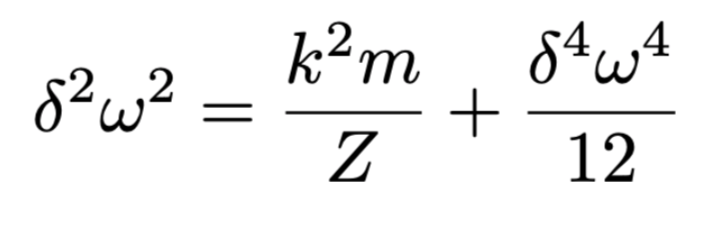
Finally, solving for ω2:
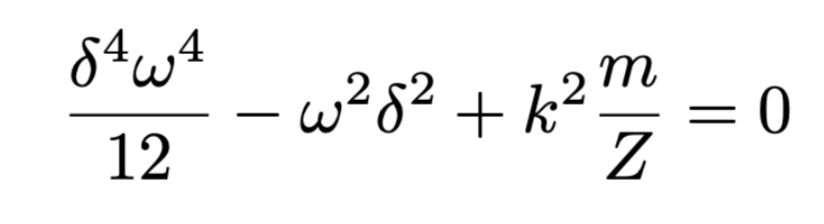
We introduce ω2 = a:
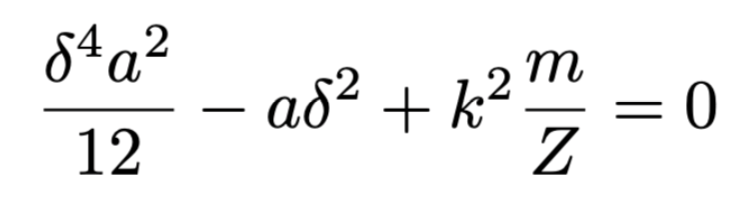
Solve for a using the quadratic formula:
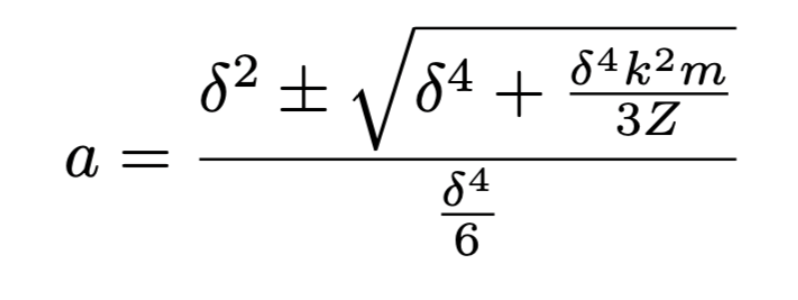
Simplifying further:
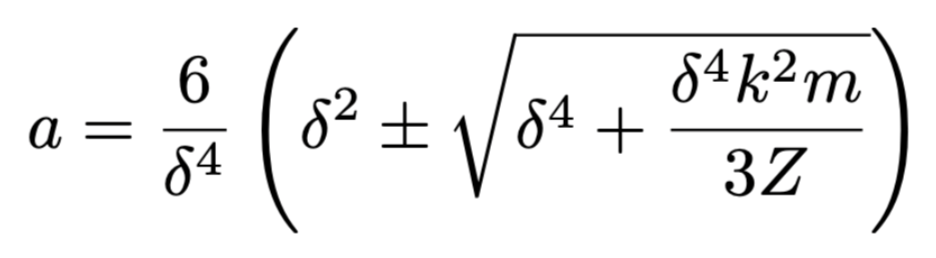
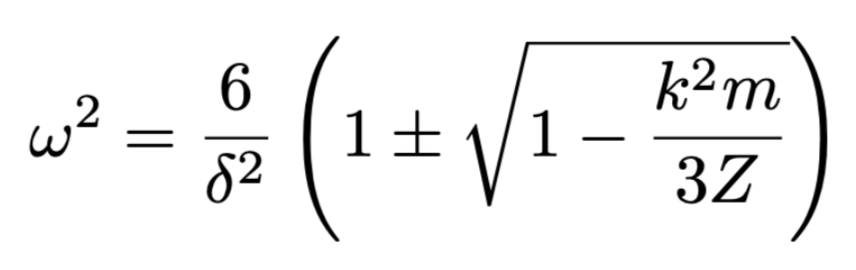
Thus, the two possible solutions for ω2 are:
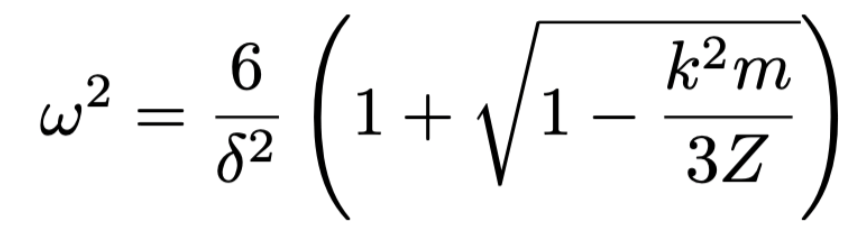
Since ω2 is positive, the solution collapses to:
The wave speed is given by:
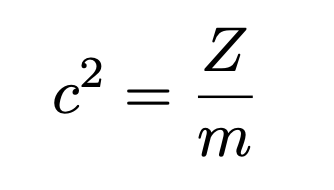
Substitute this into the equation :
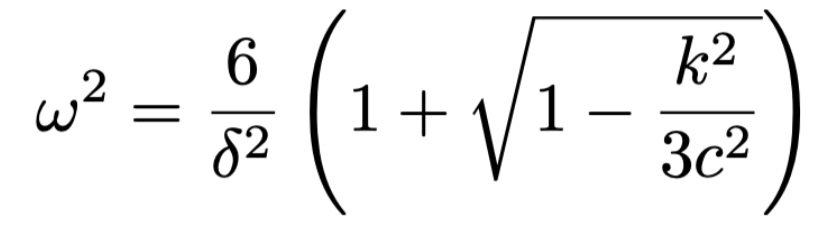
This is the dispersion relation where ω2 depends on wavenumber k, the lattice spacing δ, and the wave speed c.
Concluding Remarks
This idea illustrates that dispersion can be understood as something far more fundamental, unlike the field of transformation optics, which often introduces concepts to general relativity through analogies with classical optics. As many current theoretical models suggest, the dispersive effects arise naturally without relying on external analogies if we accept space as granular.
We have derived that the influence of dispersion becomes evident when considering a discrete arrangement of oscillators. Even when a relatively long wave passes through, compared to the spacing of the oscillators, it remains affected by the dispersion relation.
If spacetime exhibits a similar structure, we observe a negative modification term in the dispersion, which arises from systems involving discrete oscillators.
But can a positive dispersive term occur, and what would it imply? In our analysis, for the system to be physical, we choose the term where the ω2 term is positive. If it were negative, we would obtain a positive dispersion term. But is this physical? It turns out, yes.

This occurs in Bose-Einstein condensates, where the dispersion is positive rather than negative. This suggests that Bose-Einstein condensates behave like oscillators with purely imaginary distances.
These two forms of dispersion—one with a minus sign and one with a plus—represent the fundamental relations.
by Eren Erberk Erkul